Korea Nomad Forum: From Digital Nomad to Founder in Korea
Korea funds founders, and more of that support is open to foreigners than people realise. What founders and nomads said at the first Korea Nomad Forum in Songdo.
Something is changing in the Korean nomad community, and the numbers show it. More than half of this year's Digital Nomads Incheon participants are freelancers, founders or under the Digital Nomad Visa F-1-D. A growing number of our members are preparing for holding a startup visa in Korea.
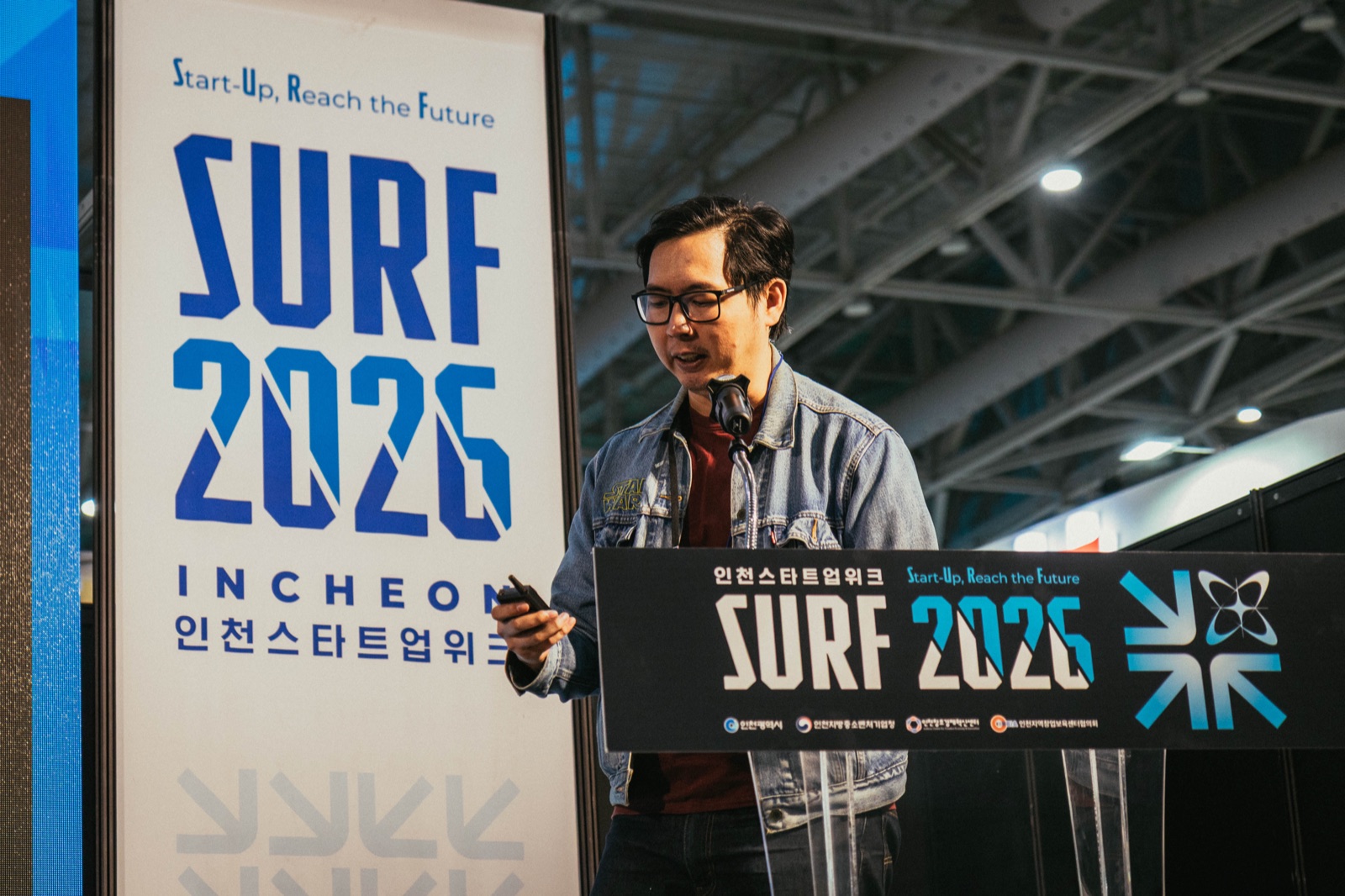
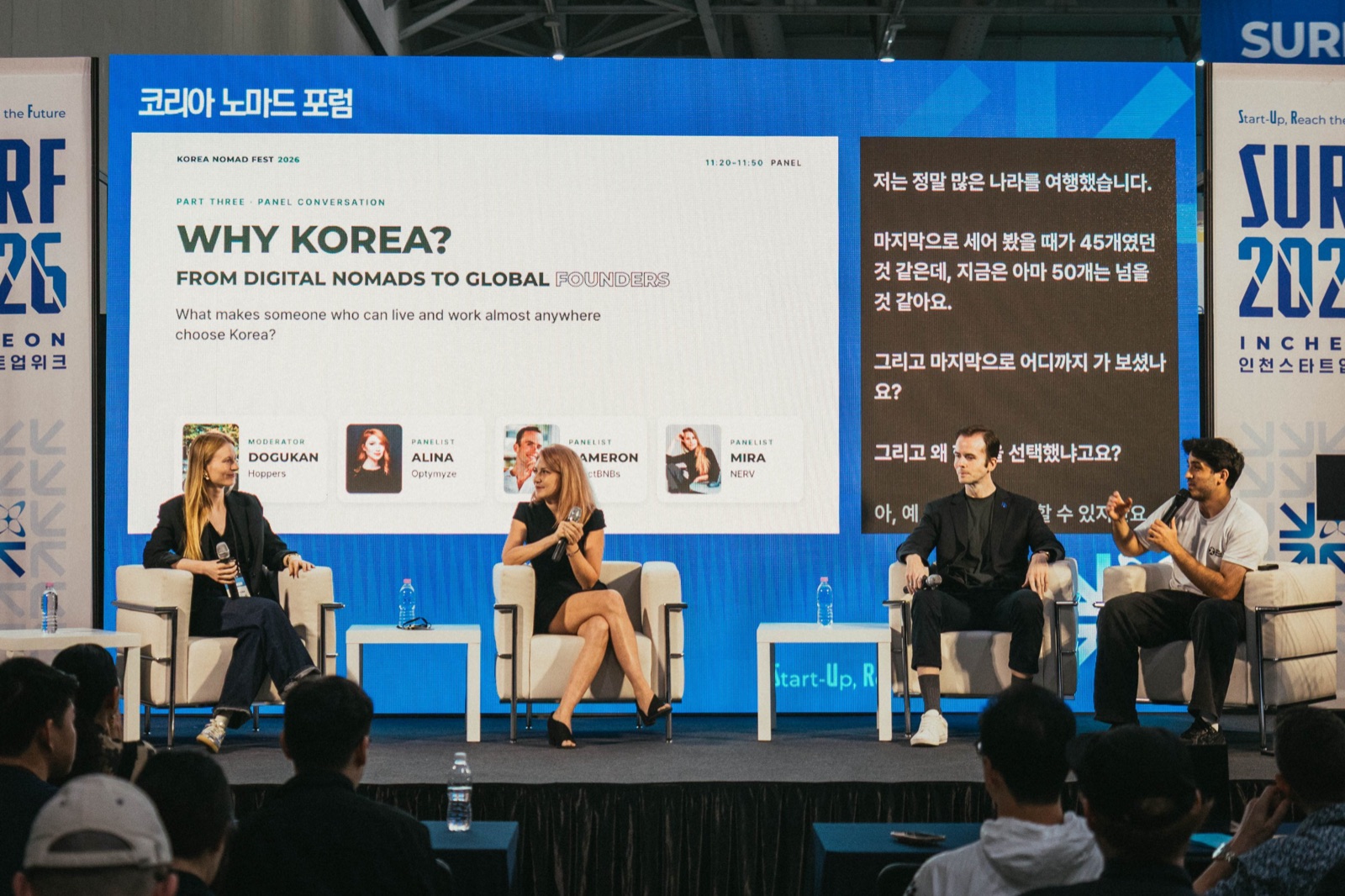
So we built the first Korea Nomad Forum around it, on October 15 at Songdo Convensia, inside SURF 2026 Incheon. Two hours, three parts. Keynotes on how Korea, Taiwan and Japan are each building a nomad ecosystem. Founders from the community pitching what they are building here. And a panel on one question: what makes someone who can live and work almost anywhere choose Korea? Dogukan Atar from Hoppers moderated that last part, with Alina Radulescu of Optymyze, Cameron Impastato of SelectBNBs and Mira Fricke of NERV.
What came out of it was less inspiring and more useful than we expected.

First, three countries made their case
Before the panel, Korea, Taiwan and Japan each took fifteen minutes on the same question: how do you actually build a nomad ecosystem? The public sector's role, private initiatives, association-building, international collaboration.
Jeong Hyun Cho, founder of Hoppers and Digital Nomads Korea, opened with the question that has driven the community since the weekly meetup days.
“Inviting digital nomads to a city is only the beginning. What matters next is what makes them want to stay and return.”

Kai Hsu, President of the Taiwan Digital Nomad Association, spoke on building Taiwan's digital nomad ecosystem. He went through what Taiwan offers nomads, and explained how the Taiwanese visa works.

Chikako Tsuda of FUTRWORKS followed with Japan's approach, and why Osaka can work as an entry point to the rest of the country rather than a destination on its own.

Korea's own nomad visa changed this year, in the applicant's favour. The pilot asked everyone for twice the per capita GNI and capped the stay at two years. Since the visa was formalised on June 30, 2026, the threshold is tiered by age and by where you live, with the lowest band for applicants aged 18 to 34 outside the capital area, and the maximum stay is three years.
Which matters if you looked at Korea a year ago and decided the income bar was out of reach.
Nomad Startup Showcase: what nomads are building here
Thirty minutes, short pitches, founders from the community showing what they are actually building in Korea.
SelectBNBs, from Cameron Impastato, gives distinctive properties a stronger path to discovery instead of letting them disappear into the big booking platforms, where design and character get flattened into price and availability. He works with owners of visually compelling homes, cabins and boutique stays across Korea, Japan and the US.

K-Rural, from Leo Harker, is an independent discovery platform for abandoned homes, traditional hanok properties and rural restoration projects across South Korea. Thousands of rural properties here sit empty: farmhouses, stone-walled cottages, century-old hanok left behind as people moved to the cities. K-Rural aggregates the listings, translates the key details into English, and gives international buyers and remote workers enough context to understand what is available and what is involved in bringing a place back to life. More on how it started below.

NERV, from Mira Fricke, helps busy minds manage stress and focus without meditation. Her starting point is that when your body is stuck in threat mode, thinking your way out does not work, so NERV uses short body-based exercises and science-backed lessons to train the nervous system directly. Two minutes, no sitting still, no empty mind required. She built it after overcoming chronic pain herself and finding no app that explained the mind-body connection clearly enough. It is free on iOS and in early testing.

GolemCodes, from Malaysia-based Kevin Tan, gives engineering teams a more disciplined way to use AI coding agents, instead of letting them burn through tokens and produce inconsistent code. It focuses on multi-agent orchestration, cost control and structured development workflows, so AI assistance turns into reliable output rather than ad-hoc generation.
The panel: why Korea, when you can work from anywhere?
To close the Forum, Dogukan Atar put the question to Alina, Cameron and Mira. It turned into the most practical half hour of the morning: money, visas, the programs that are now open to foreigners, and the reason most people never find them.
Korea funds founders, and more of it is open to foreigners now
This is the part most people outside Korea don't know.
Korea puts public money into startup support through grants, accelerators, incubators and programs run by cities and national agencies. What Cameron pointed to is that more of it is now reaching foreign founders.
Cameron Impastato is American and founded SelectBNBs, which gives distinctive properties a stronger path to discovery instead of letting them disappear into OTA search results. He works with owners of visually compelling homes, cabins and boutique stays across Korea, Japan and the US, turning attention into direct bookings. He put it this way.
“Korea puts real money and real programs behind founders, and what stands out to me is that more of that support is now open to foreigners too.”
That is the headline. If you've been assuming Korea is a nice place to work from but a closed shop for building a company, that assumption is out of date.
The real barrier isn't eligibility. It's finding out any of this exists
Cameron was equally direct about the hard part, and this is the sentence worth tattooing somewhere.
Much of the information is still Korean-only, or spread across different agencies with no single place that pulls it together.
“Once you're connected, though, people are very willing to help.”
So the barrier is informational, not legal. Which is good news in one sense, because information problems are solvable by knowing people, and bad news in another, because you can't Google your way past it.
This is also, bluntly, why we keep putting our workations inside Korean startup festivals rather than next to them. You don't find these programs by searching. You find them because someone in the room mentions one.
Step one: the digital nomad visa (F-1-D)
Alina Radulescu came to Korea from Romania as a traveller. She lives here now on the digital nomad visa.
“What really made the difference were the people and the connections I built here. After coming back several times, the Digital Nomad Visa gave me the opportunity to stay longer, continue working remotely, and actually build a life here.”
Notice the order in that sentence. The connections came first, over several visits. The visa came after, and what it bought her was time.
That's the honest way to think about the F-1-D. It isn't a founder visa and it won't make you one. What it does is remove the ninety-day clock, which is the thing that makes it impossible to build anything. You can't develop a network, test an idea or get into a program when you have to leave in six weeks.
Alina also talked about where the visa could go further, which is a fair point and one Korea is still working through.
“I first came to Korea as a traveler, but the people I met here made me want to stay longer. If digital nomads can share their experiences and challenges at gatherings like Korea Nomad Fest, and their voices are reflected in policy, Korea can become more than a place to visit. It can truly become home.”

Step two: where the nomad visa stops
The nomad visa is for working remotely for clients and employers outside Korea. The moment you want to register a company here, hire someone, raise money or sell to Korean customers, you're in different territory and you need a different visa.
That's where Korea's startup visa and the OASIS program come in, and it's the step a growing number of our community are now at.
We're not going to summarise the requirements here, because they change and because getting them wrong is expensive. We have a full guide to the startup visa on the blog, and the panel's practical advice was simpler anyway: talk to someone who has done it before you talk to an agency.
What it looks like when it works
Leo Harker's path is a good illustration, because none of it was planned.
He came from the UK. He helped renovate a hanok in Tongyeong and discovered, the hard way, how difficult it is to find rural property in Korea when you're a foreigner. No central listings, no English, and a lot of empty houses nobody is marketing.
So he built K-Rural, on the belief that these places deserve a second life. He's now part of the government's Everyone's Startup program.
“Korea Nomad Fest gave me my first opportunity to pitch Rural Living Korea, which was a fantastic learning experience and great preparation for pitches in the future.”
And then the part that makes the point about information. The day after the festival, at a startup support session run by Incheon CCEI, Leo heard about the K-Startup Grand Challenge for the first time. He's applying next year.
He'd been in Korea, building a company, and found out about one of the country's flagship foreign founder programs by sitting in a room.
If you're thinking about it
Four things we took away from the morning, in the order they actually happen.
- Come more than once before you commit. Alina came back several times before the visa made sense. Nobody on that stage decided to build in Korea on their first trip.
- Buy yourself time before you buy anything else. The nomad visa isn't the goal, it's the thing that makes the rest possible.
- Get into rooms, not search results. The programs exist and you probably qualify for more than you think. You will hear about them from people, not from Google.
- Ask someone who's done it. Visa rules change, agencies give partial answers, and the community has people at every stage of this.
That last one is the easiest, and it's free. Our meetups run all year.

Come and ask in person
- Follow the festival at koreanomadfest.com
- Follow us on Instagram
- Cities, programs and accelerators who want to reach foreign founders: hello@digitalnomadskorea.com
Korea Nomad Forum: From Digital Nomad to Founder in Korea
Korea funds founders, and more of that support is open to foreigners than people realise. What founders and nomads said at the first Korea Nomad Forum in Songdo.
Something is changing in the Korean nomad community, and the numbers show it. More than half of this year's Digital Nomads Incheon participants are freelancers, founders or under the Digital Nomad Visa F-1-D. A growing number of our members are preparing for holding a startup visa in Korea.
So we built the first Korea Nomad Forum around it, on October 15 at Songdo Convensia, inside SURF 2026 Incheon. Two hours, three parts. Keynotes on how Korea, Taiwan and Japan are each building a nomad ecosystem. Founders from the community pitching what they are building here. And a panel on one question: what makes someone who can live and work almost anywhere choose Korea? Dogukan Atar from Hoppers moderated that last part, with Alina Radulescu of Optymyze, Cameron Impastato of SelectBNBs and Mira Fricke of NERV.
What came out of it was less inspiring and more useful than we expected.
First, three countries made their case
Before the panel, Korea, Taiwan and Japan each took fifteen minutes on the same question: how do you actually build a nomad ecosystem? The public sector's role, private initiatives, association-building, international collaboration.
Jeong Hyun Cho, founder of Hoppers and Digital Nomads Korea, opened with the question that has driven the community since the weekly meetup days.
“Inviting digital nomads to a city is only the beginning. What matters next is what makes them want to stay and return.”
Kai Hsu, President of the Taiwan Digital Nomad Association, spoke on building Taiwan's digital nomad ecosystem. He went through what Taiwan offers nomads, and explained how the Taiwanese visa works.
Chikako Tsuda of FUTRWORKS followed with Japan's approach, and why Osaka can work as an entry point to the rest of the country rather than a destination on its own.
Korea's own nomad visa changed this year, in the applicant's favour. The pilot asked everyone for twice the per capita GNI and capped the stay at two years. Since the visa was formalised on June 30, 2026, the threshold is tiered by age and by where you live, with the lowest band for applicants aged 18 to 34 outside the capital area, and the maximum stay is three years.
Which matters if you looked at Korea a year ago and decided the income bar was out of reach.
Nomad Startup Showcase: what nomads are building here
Thirty minutes, short pitches, founders from the community showing what they are actually building in Korea.
SelectBNBs, from Cameron Impastato, gives distinctive properties a stronger path to discovery instead of letting them disappear into the big booking platforms, where design and character get flattened into price and availability. He works with owners of visually compelling homes, cabins and boutique stays across Korea, Japan and the US.
K-Rural, from Leo Harker, is an independent discovery platform for abandoned homes, traditional hanok properties and rural restoration projects across South Korea. Thousands of rural properties here sit empty: farmhouses, stone-walled cottages, century-old hanok left behind as people moved to the cities. K-Rural aggregates the listings, translates the key details into English, and gives international buyers and remote workers enough context to understand what is available and what is involved in bringing a place back to life. More on how it started below.
NERV, from Mira Fricke, helps busy minds manage stress and focus without meditation. Her starting point is that when your body is stuck in threat mode, thinking your way out does not work, so NERV uses short body-based exercises and science-backed lessons to train the nervous system directly. Two minutes, no sitting still, no empty mind required. She built it after overcoming chronic pain herself and finding no app that explained the mind-body connection clearly enough. It is free on iOS and in early testing.
GolemCodes, from Malaysia-based Kevin Tan, gives engineering teams a more disciplined way to use AI coding agents, instead of letting them burn through tokens and produce inconsistent code. It focuses on multi-agent orchestration, cost control and structured development workflows, so AI assistance turns into reliable output rather than ad-hoc generation.
The panel: why Korea, when you can work from anywhere?
To close the Forum, Dogukan Atar put the question to Alina, Cameron and Mira. It turned into the most practical half hour of the morning: money, visas, the programs that are now open to foreigners, and the reason most people never find them.
Korea funds founders, and more of it is open to foreigners now
This is the part most people outside Korea don't know.
Korea puts public money into startup support through grants, accelerators, incubators and programs run by cities and national agencies. What Cameron pointed to is that more of it is now reaching foreign founders.
Cameron Impastato is American and founded SelectBNBs, which gives distinctive properties a stronger path to discovery instead of letting them disappear into OTA search results. He works with owners of visually compelling homes, cabins and boutique stays across Korea, Japan and the US, turning attention into direct bookings. He put it this way.
“Korea puts real money and real programs behind founders, and what stands out to me is that more of that support is now open to foreigners too.”
That is the headline. If you've been assuming Korea is a nice place to work from but a closed shop for building a company, that assumption is out of date.
The real barrier isn't eligibility. It's finding out any of this exists
Cameron was equally direct about the hard part, and this is the sentence worth tattooing somewhere.
Much of the information is still Korean-only, or spread across different agencies with no single place that pulls it together.
“Once you're connected, though, people are very willing to help.”
So the barrier is informational, not legal. Which is good news in one sense, because information problems are solvable by knowing people, and bad news in another, because you can't Google your way past it.
This is also, bluntly, why we keep putting our workations inside Korean startup festivals rather than next to them. You don't find these programs by searching. You find them because someone in the room mentions one.
Step one: the digital nomad visa (F-1-D)
Alina Radulescu came to Korea from Romania as a traveller. She lives here now on the digital nomad visa.
“What really made the difference were the people and the connections I built here. After coming back several times, the Digital Nomad Visa gave me the opportunity to stay longer, continue working remotely, and actually build a life here.”
Notice the order in that sentence. The connections came first, over several visits. The visa came after, and what it bought her was time.
That's the honest way to think about the F-1-D. It isn't a founder visa and it won't make you one. What it does is remove the ninety-day clock, which is the thing that makes it impossible to build anything. You can't develop a network, test an idea or get into a program when you have to leave in six weeks.
Alina also talked about where the visa could go further, which is a fair point and one Korea is still working through.
“I first came to Korea as a traveler, but the people I met here made me want to stay longer. If digital nomads can share their experiences and challenges at gatherings like Korea Nomad Fest, and their voices are reflected in policy, Korea can become more than a place to visit. It can truly become home.”
Step two: where the nomad visa stops
The nomad visa is for working remotely for clients and employers outside Korea. The moment you want to register a company here, hire someone, raise money or sell to Korean customers, you're in different territory and you need a different visa.
That's where Korea's startup visa and the OASIS program come in, and it's the step a growing number of our community are now at.
We're not going to summarise the requirements here, because they change and because getting them wrong is expensive. We have a full guide to the startup visa on the blog, and the panel's practical advice was simpler anyway: talk to someone who has done it before you talk to an agency.
What it looks like when it works
Leo Harker's path is a good illustration, because none of it was planned.
He came from the UK. He helped renovate a hanok in Tongyeong and discovered, the hard way, how difficult it is to find rural property in Korea when you're a foreigner. No central listings, no English, and a lot of empty houses nobody is marketing.
So he built K-Rural, on the belief that these places deserve a second life. He's now part of the government's Everyone's Startup program.
“Korea Nomad Fest gave me my first opportunity to pitch Rural Living Korea, which was a fantastic learning experience and great preparation for pitches in the future.”
And then the part that makes the point about information. The day after the festival, at a startup support session run by Incheon CCEI, Leo heard about the K-Startup Grand Challenge for the first time. He's applying next year.
He'd been in Korea, building a company, and found out about one of the country's flagship foreign founder programs by sitting in a room.
If you're thinking about it
Four things we took away from the morning, in the order they actually happen.
- Come more than once before you commit. Alina came back several times before the visa made sense. Nobody on that stage decided to build in Korea on their first trip.
- Buy yourself time before you buy anything else. The nomad visa isn't the goal, it's the thing that makes the rest possible.
- Get into rooms, not search results. The programs exist and you probably qualify for more than you think. You will hear about them from people, not from Google.
- Ask someone who's done it. Visa rules change, agencies give partial answers, and the community has people at every stage of this.
That last one is the easiest, and it's free. Our meetups run all year.
Come and ask in person
- Follow the festival at koreanomadfest.com
- Follow us on Instagram
- Cities, programs and accelerators who want to reach foreign founders: hello@digitalnomadskorea.com